

REQUEST AN APPOINTMENT
LET'S CONNECT NOW
Schedule your no obligation consultation by fill out the form below.

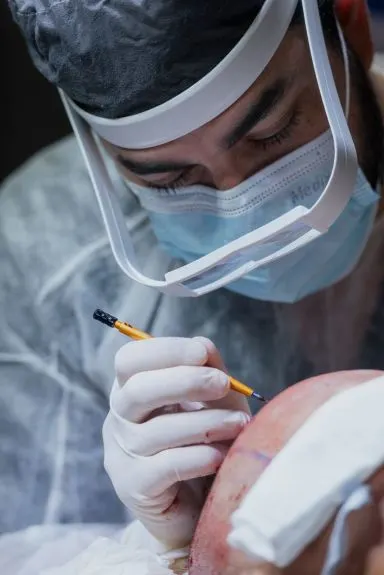
Hair transplantation has changed considerably over the years. Modern techniques can create natural-looking results, but outdated information, social media claims and unrealistic before-and-after expectations can still leave patients confused about what a hair transplant can actually achieve.
The key point: A hair transplant redistributes existing hair follicles from a donor area to areas affected by thinning or baldness. It does not create an unlimited supply of new hair. The final result depends on factors such as the cause and pattern of hair loss, donor supply, hair characteristics, treatment planning and individual healing.
A hair transplant creates completely new hair.
Hair follicles are moved from a donor area to a recipient area, so donor supply matters.
Everyone with hair loss is automatically a good candidate.
The cause of hair loss, donor density and future hair-loss pattern all matter when assessing suitability.
The myth: Hair transplantation is sometimes described as a way to "grow new hair" on a bald scalp.
The fact: A transplant redistributes existing hair follicles. Hair-bearing follicles are harvested from a donor area and placed into areas where greater coverage is desired. This means the amount of available donor hair is one of the important limitations of transplantation.
The goal is therefore not necessarily to restore every lost hair. Instead, a well-planned transplant aims to use the available donor follicles efficiently to create useful coverage and a natural appearance.
Fact: Both men and women can potentially be candidates for hair transplantation. However, the pattern and cause of hair loss are particularly important when evaluating women.
Some women with female pattern hair loss may benefit from transplantation, while others may have diffuse thinning across the scalp and insufficient donor density. Other causes of hair loss may require medical treatment rather than surgery.
A proper diagnosis is therefore more important than simply asking whether a person is male or female.
Not necessarily. A transplant may be considered for certain types of permanent hair loss, but not every cause of hair loss is suitable for surgical restoration.
Selected patients with pattern hair loss and an adequate supply of healthy donor hair.
People whose hair loss is caused by conditions that require medical treatment or whose donor supply is inadequate.
The cause of hair loss should be established before surgery. A scalp examination and, in some cases, additional investigations may be recommended.
Fact: FUE, or follicular unit extraction, involves removing individual follicular units from the donor area using small punches. It generally avoids the linear donor scar associated with strip harvesting, but it does not mean that the procedure leaves absolutely no marks.
| Technique | Basic approach | Donor-area consideration |
|---|---|---|
| FUE | Individual follicular units are extracted and transplanted. | Leaves multiple small extraction sites rather than one linear scar. |
| FUT | A strip of hair-bearing skin is removed and divided into grafts. | Leaves a linear scar that may be visible with very short hairstyles. |
Neither technique is automatically right for every patient. The choice depends on donor characteristics, the extent of hair loss, treatment goals, hairstyle preferences and the surgeon's assessment.
Fact: FUE and FUT are different donor-harvesting approaches rather than a simple "good versus bad" comparison. FUE can avoid a linear strip scar, while FUT can remain useful in appropriately selected patients. The most suitable method depends on individual circumstances.
Be cautious of clinics that automatically recommend the same technique to every patient without examining the donor area and discussing your long-term hair-loss pattern.
A transplant can improve coverage, but there are biological and practical limits to the number of grafts that can safely be harvested. The objective is usually to create the appearance of greater density rather than reproduce the exact hair density you had as a child.
The available donor supply needs to be considered alongside the size of the thinning area and the possibility of future hair loss. Using too many grafts early may leave fewer options for future treatment.
This statement needs some clarification.
After transplantation, the visible hair shafts from newly transplanted follicles commonly shed during the early healing period. This does not necessarily mean that the transplant has failed. New growth takes time.
The American Academy of Dermatology notes that many patients begin seeing results around six to nine months after surgery, while some may take around 12 months. The NHS notes that full results can take considerably longer depending on the individual and procedure.
Patience during the growth phase is therefore an important part of the transplant journey.
Fact: A transplant treats the areas receiving transplanted follicles, but it does not necessarily stop the underlying process causing pattern hair loss elsewhere on the scalp.
This is one reason why medical treatment may sometimes be recommended alongside or after transplantation. Managing ongoing hair loss can help preserve the appearance of the surrounding natural hair.
A hair transplant is not an instant transformation. The transplanted follicles need time to settle, the early hair shafts may shed, and new growth develops gradually.
Hair transplantation is usually performed using local anaesthesia, so the scalp is numbed during the procedure. Patients may experience some discomfort, tightness, swelling or soreness during recovery, but the experience varies from person to person.
It is more useful to ask a surgeon about the expected discomfort, anaesthesia, pain-management plan and recovery rather than assuming that every patient's experience will be the same.
There is a finite supply of donor follicles. A responsible transplant plan should therefore consider both the current area of hair loss and the possibility of future thinning.
The goal is not simply to transplant the maximum possible number of grafts. It is to use the available donor hair strategically while maintaining a natural-looking donor area and allowing for the patient's future needs.
Older hair-restoration techniques sometimes produced an unnatural "plugged" appearance. Modern transplantation uses smaller follicular units and more careful hairline and graft placement, which can produce natural-looking results when appropriately planned and performed.
However, "natural-looking" should not be interpreted as a guarantee. Hairline design, graft placement, donor quality, hair characteristics and surgical technique all influence the final appearance.
Starting to lose hair at a young age can be distressing, but early hair loss does not automatically mean that immediate transplantation is the best approach.
In younger patients, the future pattern of hair loss may still be developing. A dermatologist or hair-restoration surgeon may recommend stabilising hair loss medically and monitoring progression before considering surgery.
The important question is not "Am I young enough?"
It is whether the cause and pattern of hair loss are understood, whether the donor supply is adequate, whether expectations are realistic and whether a transplant makes sense as part of a long-term hair-loss plan.
Hair transplantation is primarily a hair-restoration procedure, but hair loss can affect how people feel about their appearance and confidence. Some patients may experience an improvement in self-image after successful treatment.
At the same time, expectations matter. A transplant cannot guarantee a particular appearance or completely reverse every aspect of hair loss. A consultation should focus on what is realistically achievable for the individual's donor supply and hair-loss pattern.
When researching a hair transplant in Hyderabad, it can be tempting to compare clinics mainly by graft numbers, package prices or promotional offers. But those figures do not tell the whole story.
The more useful questions concern who evaluates you, who performs the procedure, how the donor area is assessed, how the hairline is designed, how grafts are handled and what follow-up is provided.
A consultation can help determine the cause of your hair loss, assess your donor area and discuss realistic restoration options.
Book a ConsultationTransplanted follicles can provide long-lasting or permanent growth in appropriately selected patients, but the overall appearance can still change because non-transplanted hair may continue to thin. Long-term hair-loss management may therefore still be important.
No. FUE avoids the linear strip scar associated with FUT, but individual extraction sites can leave tiny marks or scars. Their visibility varies between patients.
The transplanted hair shaft commonly sheds during the early post-operative period before new growth develops. This can be a normal part of the transplant process.
Growth is gradual. Many patients begin seeing noticeable results around six to nine months, while maturation can take longer. Your surgeon should provide an individual timeline.
Yes. Some women with suitable patterns of hair loss and adequate donor hair may be candidates. However, diffuse thinning and certain medical causes of hair loss may make transplantation less suitable.
No. A transplant does not necessarily stop the underlying process causing pattern hair loss. Natural hair around the transplanted area may continue to thin, which is why ongoing medical management may sometimes be recommended.
Neither technique is universally better. FUE and FUT use different methods to obtain donor grafts, and the appropriate choice depends on factors such as donor characteristics, treatment goals, hair-loss pattern and individual circumstances.
Not necessarily. There is a finite donor supply, so transplantation aims to create the best possible coverage and appearance within those limitations rather than reproduce every lost follicle.
Medical Disclaimer: This article is intended for general educational purposes and does not replace an individual medical consultation. Hair transplantation is a surgical procedure and is not suitable for every type or cause of hair loss. Suitability, expected results, risks, recovery and treatment options should be discussed with a qualified healthcare professional. Individual results vary.


